

It’s hard to believe that Metroid Prime 4: Beyond is real and finally available for the world to play. This game has been on everyone’s waiting list for the past 18 years. The hype that I had for this game was immense since it was first properly announced years back. I was pretty stunned to see that Nintendo announced via its social media accounts in 2019 that the game’s development had been scrapped due to “not meeting Nintendo’s standards.” They had never been so candid, so it must have been in pretty rough shape to have been publicly restarted like that. After nearly 6 years of nonstop work on the brand new iteration of the game, we finally got what Nintendo had been hyping up. I’ve now played Metroid Prime 4, and I can say confidently that not only was it not worth the wait, but it’s actually the most disappointing I’ve been with a mainline Nintendo game in a very, very long time.
What makes a good Metroid game? Well, I’d argue it’s a mix of its ambiance and its satisfying world design. I think the finest example of this combo is in the first Metroid Prime. Having recently replayed the remastered version on the Switch, it feels so confident. There is zero handholding, which can be almost stupefying, but because it peppers hints in your direction, you never feel lost. In fact, there are moments where you’ll naturally progress and unlock a brand new item and simultaneously discover a shortcut back to a room you’ve previously been to. Now, with your new item equipped, you’re able to get past the seemingly impossible room. It’s a very satisfying puzzle loop that makes the world feel less labyrinthine and more like an escape room. The world is designed with such intention to detail, and the way it all seemingly loops in on itself is rivalled only by a small handful of games. The Hollow Knight series comes to mind as games that took this already well-aged mechanic and philosophy in level design and evolved them into something sophisticated and new. Metroid Prime 4, on the other hand, somehow fell backwards and landed on its ass, delivering a world that feels linear and widely uninteresting.

Of the dozens of Metroidvanias I have played across the years, Metroid Prime 4 is among the least interesting. The major issue with this game is that all its power-ups and unlocks are treated like keys rather than innovative tools in your kit. There was one time I saw a door that looked slightly too high for me to reach. “I bet I could get that with a double jump,” I thought. Soon after I unlocked a double jump, went back to the door, and got in… that’s it. That’s typically how these moments of “puzzle solving” are handled. I could count on one hand the number of times across my playthrough where I thought “oh, that was an interesting solution.” You’re very rarely given a section that shows the capabilities of each unlock you get, and the unlocks are typically only used to get you through a door. That’s what I mean when I say they feel more like keys, because most of the time, for all intents and purposes, they are keys.

As part of the game’s story, Samus is equipped with psychic abilities. Through the game, you’ll use these abilities to unlock doors, manipulate gems on structures, and set up throwable explosives in combination with your Morph Ball. Possibly the most interesting way to use the abilities is by shooting a telekinetic blast that can be controlled. When shot, time comes to a crawl as you are able to dictate the path of the blast, and you can get a few hits in before it disappears. This is often used in puzzle-solving sections that feel pretty easy most of the time. It’s also necessary in some combat scenarios, which sounds cool, but in practice, it’s more frustrating than anything. There are several bosses that require you to use this mechanic, and these were easily my least favourite fights in the game. The momentum of the fight comes to a halt, and you’re forced to use this psychic missile that’s difficult to pilot, has a janky hitbox, and always manages to overshoot the target you’re going for. The windows to use these blasts are often so short that if you miss one of these, you’ll be forced to sit through the boss cycling the same three or four moves until you can get back to another shot at using the remote-controlled missile. If you get hit while controlling it, the animation will be cancelled, and you’ll have to wait AGAIN. It’s just layers on top of layers of frustration that drove me mad too many times.
Speaking of things that drove me mad, I’ve got two words for you – Myles MacKenzie. As far as I’m concerned, this guy is the antithesis of what makes a Metroid Prime game a Metroid Prime game. As I mentioned previously, Metroid Prime has always been about the ambiance and level design. I explained why I feel like the level design failed, but Myles is one of the many reasons why the ambiance fails. This game has minuscule ambiance – microscopic even. Metroid Prime 1 felt desolate and suffocating. Samus was all alone and had a helpful hint system built into her suit. You could use it if you wanted, or you could play the game with minimal handholding if you preferred that style. Even if you wanted help, you could scan your surroundings, and the suit would give you an idea as to what you’re meant to do. This hint-giving system fits the core themes of the game and also forces you to think critically at every step. It’s the main reason I never beat the first game as a child. Metroid Prime 4 has Myles MacKenzie – an annoying MCU-coded dweeb who doesn’t know how to shut the fuck up. Funny enough, he’s the main reason I’ll probably never replay Metroid Prime 4.

The instant Myles joins your party, he immediately says you should check out your map, and then suggests you should find a place to save your progress, and then talks about how he can’t believe you’re really next to him. And then a few seconds later, he’ll tell you to go save your game and check out the map. And then a few minutes after that, he’ll tell you to go check out that door over there, and maybe you should check your map. He repeats this cycle over and over and over again. I just wanted to slam my head into the nearest wall. Samus doesn’t have any time to think or any time to absorb the ambiance in this game because Myles always has something to say. Samus’ muteness doesn’t make any sense in this game because the characters are constantly talking to her and she can’t respond, making her come off as some socially awkward psychopath who can’t convey any emotions or empathy. When you’re with Myles, he will make quips in your face while you just stand there like a statue. It’s just so awkward in a way that silent protagonists haven’t been before. The fact that they didn’t give Samus a personality just makes interacting with any of the game’s characters even more ferociously painful to sit through. But even if you leave Myles, he’ll still reach out to you over the radio. He’ll chime in when you’re halfway through a level, or in combat, or if you stop moving for like five seconds. He’s always buzzing in your ear like a mosquito who’s got it out for you. He also chimes in when you drive Vi-O-La in a direction you’re not “supposed” to be going yet. I should talk about Vi-O-La…
I’m just going to say Viola from here on out, because it’s annoying to type its proper name. Viola is a motorcycle that you gain access to. You might be thinking, well, the Metroid Prime 4 games take place in worlds that are usually small corridors filled with big, contained combat spaces. Where would you even use a motorcycle? Metroid Prime 4 decided to completely throw the Metroidvania formula in favour of a giant empty soulless desert. First off, the desert is gigantic and completely void of any personality or flavour. It is not fun to drive through, and it takes a painfully long time to cross it. Viola apparently travels at a speed averaging hundreds of miles or kilometres (the speedometer just says the number and not the unit of speed). Still, you’d never know that, given how slow it feels in this place. There are the same 2 enemies that spot across the empty wasteland, and you can just drive right past them. Viola has rockets, but they take too long to charge between shots, and they don’t do much damage. Fighting on the bike just feels bad, and riding the bike through the desert also feels bad.
Every now and then, you’ll come across these random Zelda-like shrines that require you to have certain power-ups to access. What’s annoying is that in the desert, the power-ups literally act as keys. You just use it on a door to get inside, there’s no thought put into how to enter these places, you either can or you can’t. You might think, “There’s probably something interesting in there.” You’ll finally get inside and just shoot some enemies and jump your way through the shrine, and what do you get? An additional 5 rockets to shoot… which just feels bad. You almost always have rockets on hand, unless you’re just spamming them, and you are constantly finding upgrades to your rocket capacity. By the end of the game, you’ll have a hundred+ rockets, and you’ll STILL find rock capacity upgrades later on. It just feels like the rockets were placeholders for something more interesting that we never got. So does the desert sound like a bad place to be yet? Because I haven’t even talked about the worst part… those god damned green crystals.

Once you gain access to the desert, Myles MacKenzie will briefly mention that you should collect green crystals when you can. He doesn’t explain their use or their importance, and the way he says it feels very dismissive and undermines their value. So I didn’t pay much attention to them at first. If I saw a couple on my ride through the desert, I’d smack into them, but I wouldn’t go out of my way to get them. I saw a green crystal meter in the menu, so I assumed it was some sort of currency you’d use later. THEY ARE ACTUALLY THE MOST IMPORTANT COLLECTIBLE IN THE GAME. What they don’t tell you until it’s too late is that in order to gain access to the final section of the game, you need to max out the green crystal meter in the menu. While it doesn’t take 100% of the crystals in the desert, it sure takes a whole fucking lot of them! Even if you complete all the levels in the game and go to the final one, you’ll be told that you can’t enter without filling the green crystals. There is barely any lore given to these stupid rocks, and you’d have to pay me to spend another moment of my life to go back on the hunt for crystals.
The desert is so expansive and same-y across the way that it can be tough to find out if you’ve already been to that area without opening the map every five seconds. And if you have the memory of a goldfish, don’t worry! Myles will chime in every two minutes or so, telling you to collect green crystals. I actually found more joy in muting my TV while driving through the desert. It’s not like you’re missing out on any good music because, for some reason other than Myles’ constant screaming the same thing at you, the desert is COMPLETELY SILENT. The only ways to get music in the desert, a place where you will be forced to spend a lot of time, are through scanning 100% of the scannable materials in the game or by purchasing and then scanning the Viola Amiibo. That is complete and utter insanity, and I’ve never been more baffled by a decision. You also have to traverse the desert every single time you want to go back to another world for any reason. Each main area is on completely opposite ends of the desert, and there’s no fast travel, and Myles will yell at you nonstop across the 5 or so minutes it takes to get to the next place – it’s just torture. The desert is not only a mind-numbing place to navigate, but it’s also in contention for my least favourite environment in any video game ever.
Where Metroid Prime 4 could have succeeded was by finally giving fans what they wanted: Sylux. He’s been peppered across the Metroid franchise for years now and has been confirmed to be the main antagonist of this game for quite some time now. Fans had been clamouring for more information on the mysterious space pirate, and they wanted to know what kind of adversary he’d be to Samus Aran. Would you believe me if I told you that he doesn’t really do anything other than appear as a boss fight a few times, and that’s literally it? There isn’t a single cutscene that explains his motivations or what he stands for. He is only an antagonist in the purest sense of the word. He doesn’t like you, you don’t like him, and that’s all you get. He feels dramatically underused in Metroid Prime 4, and it honestly feels like a slap in the face for fans who’ve wanted more of him over the last 19 years. To call him an antagonist doesn’t feel right because he doesn’t fulfill that role much at all. You could argue that every single creature in this game is the main antagonist because they want to kill Samus. As far as I’m concerned, Sylux’s inclusion feels like a missed opportunity, and that breaks my heart.
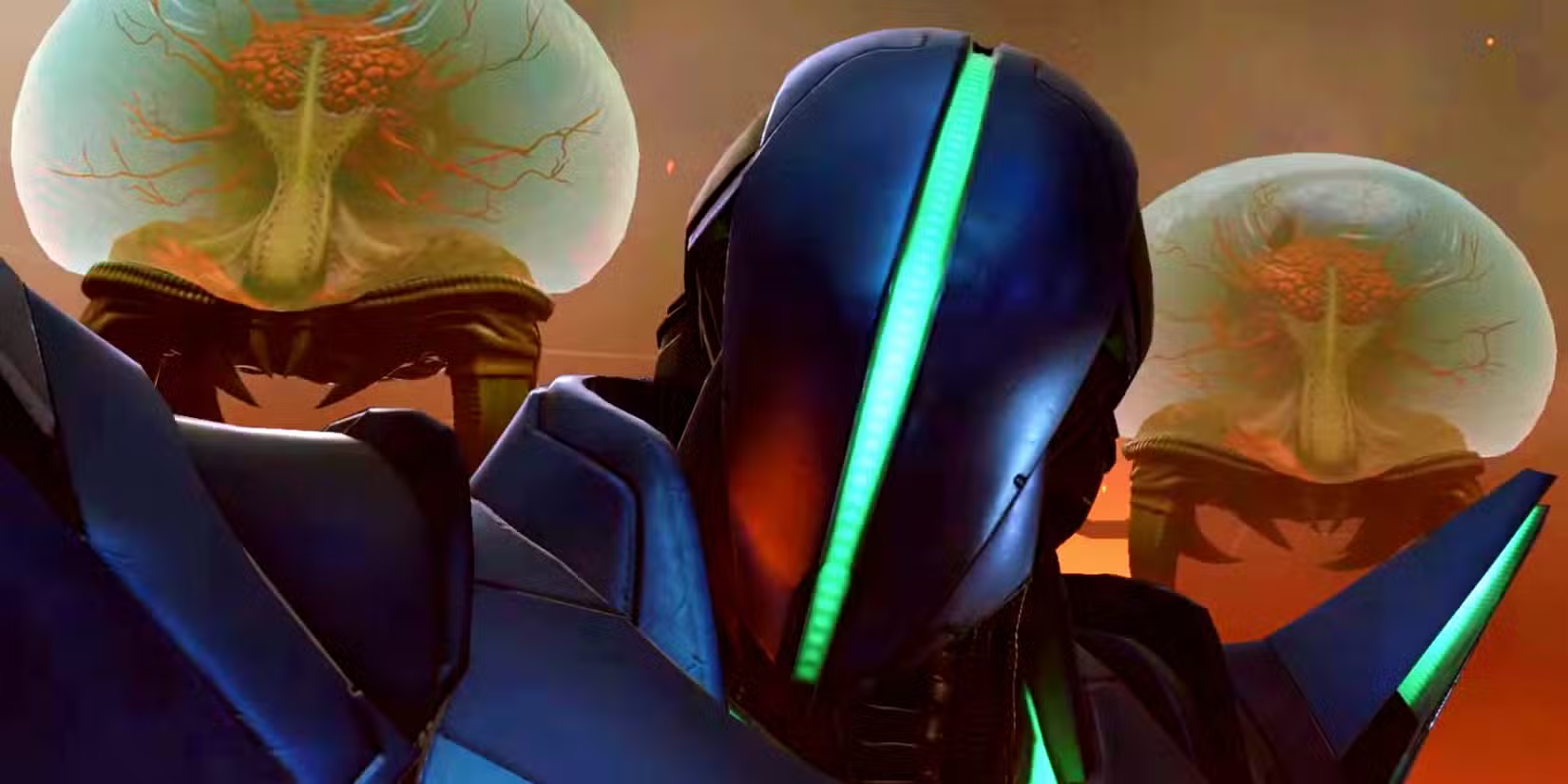
At its core, Metroid Prime 4 is still what it says on the box – it’s a Metroid Prime game. So while I have spent this entire time complaining, it’s still got the DNA of a good game. The graphics and world designs are beautiful and captivating for the most part. The snow level, in particular, is extremely well crafted and stands amongst the best levels across the series. It’s also really nice hearing the classic soundtrack, and hearing the various victory tunes fills me with a sense of joy. It’s a shame the new tracks don’t have the same bravado or triumphant nature the rest of the series has. The core gameplay is also very similar to what you’ve played in the previous Prime titles, so if that’s all you’re looking for, it’s right here.
We waited 18 years since the last entry, and it doesn’t feel like we’re playing a game designed in modern times. I seriously wonder what the scrapped version of Metroid Prime 4 looked like, because I can’t believe this game shipped in this state. This is without a doubt, no question, my least favourite mainline Nintendo game I’ve played in years. Metroid Prime 4 is filled with some of the most baffling gameplay design decisions I’ve ever seen in a video game. While it might have the DNA of the previous entries in the series, its skin, bones, and muscles are all taken from different creatures entirely. I can’t in good conscience recommend Metroid Prime 4, and that physically hurts me to type.
