



Tony Stark and his Stark Industries conglomerate create weapons of mass destruction. This is known.
Midway through the first Iron Man (2008) film, after being tortured and, after seeing his company’s products sold to terrorist organizations and used for evil purposes, Stark comes to a marked and important turning point in his life wherein he states: “I don’t want a body count to be our only legacy.” An altruistic statement, to be certain, by a man who’s bravado is only surpassed by his bank account. Still, it’s a significant distinction to make that, at this time, Stark truly sets out on the path to becoming heroic.
But in the Marvel Cinematic Universe, everything that Tony Stark creates for noble, upstanding and heroic purposes always gets twisted in ways that transform that sense of benevolence into objects of mankind’s destruction.
In creating his suit of armor in Iron Man, powered by the arc reactor in his chest (originally designed by his father, Howard Stark) which also happens to keep him alive, Tony Stark has also fashioned a new, powerful weapon to be usurped by his enemies and used for nefarious ends. Although he has stated that his new legacy is to be one of peace, and although he may have exited the business of creating and selling arms to the military, Tony hasn’t departed from the original philosophy behind his statement “peace means having a bigger stick.” It’s that very stick that Obadiah Stane, Tony’s confident and partner, wants for his own, wicked means.
Intent on continuing a legacy of immoral and reprehensible commerce, Stane subverts Stark Industries and turns on his longstanding friend, using the arc reactor to power his own armored shell (created in secret with the terrorist organization the Ten Rings) in the hopes of producing a next generation line of artillery with the intent to sell it to whoever pays, regardless of moral or political persuasion. The arc reactor, a life-giving device created for good, is transformed here, it’s meaning and usage, now much more complex. It’s a metaphor for numerous discoveries here in our own real world that have been usurped from their original intention. Julius Robert Oppenheimer is never far from the Iron Man world and it won’t be the last time this comparison is utilized in the Marvel series of films.
An early scene in the first Avengers (2012) film lays the foundation for its final act. Tony Stark, in his armor, is seen putting the finishing touches on a new use for the arc reactor technology, this time as a self-sustaining, clean energy source. The prototype device powers Stark Tower, located in Midtown Manhattan. Of course, the world has already seen the reactor appropriated by evil, and that outcome is no different in Avengers. This time, it’s the Asgardian Loki who exploits the technology which gives added power to the Tesseract and opens a wormhole gateway for the alien Chitauri invasion of earth. But it’s Stark’s quick-thinking and intelligence that helps the Avengers plan out of the threat. “When did you become an expert in thermo-nuclear astrophysics?” asks Agent Hill. “Last night,” retorts the billionaire playboy.
The aftermath of the “Battle of New York” in the Avengers film is undoubtedly one of the more disastrous combats viewed in cinema. Buildings, and indeed, entire city blocks of one of America’s most populace cities is decimated through the actions of both the antagonists of the film and its protagonists, the Avengers, despite their best efforts. Although it isn’t shown explicitly by the filmmakers, the loss of innocent life in New York City, via the wanton destruction, must be staggering and Stark technology is the catalyst for it. The arc reactor, a device built to save, inherently carries a legacy of devastation.


Indeed, over the course of four films, Stark has had to endure much physical abuse, as well as philosophical and moral subjections that many – including his father, Howard, have never had to endure. “We create our own demons,” he narrates at the beginning of Iron Man 3 – a confession for what has come before and a warning for what is still to transpire in the Marvel Cinematic Universe. In order to take responsibility over his own actions, his legacy and the obligation to a bright future for all mankind, Tony Stark willingly sets himself down a path that would see the human race once more threatened – this time with absolute extinction.

In an origin that differs from the source material found in the Avengers comic books, Avengers: Age of Ultron (2015), the second of a planned four film series starring the world-renowned comic book characters, depicts mankind’s greatest threat throughout the Marvel Cinematic Universe releases to date. “This world needs something more powerful than any of us” Stark tells those that would listen.


In the film, Ultron creates thousands of versions of himself, a robotic army at his command, while constantly upgrading his physical persona in order to better protect himself from threats like the Avengers so that he can fulfill his plan and destroy the human scourge on planet earth. These are twisted actions that are not at all dissimilar from Stark’s engineering improvements of his own metal armor and this “father-son” dynamic is evidently played out through the entirety of the film.
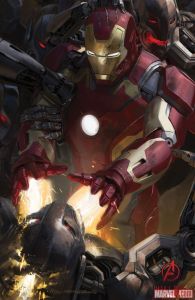

It’s a question and a trait that will certainly ensure more films and a deepening legacy and importance for Tony Stark at the center of storytelling in the Marvel Cinematic Universe.