

Joss Whedon’s triumphant summer of Cabin in the Woods and The Avengers follows a line of thought that leads all the way back to the good old “Buffyverse”. Buffy the Vampire Slayer is all about the inversion of horror conventions. A diminutive blonde cheerleader is chased down a dark alley by a monster… only to pause, turn, raise an eyebrow, pull out a sharp object, and invert the monster’s conventions directly. In that vein, Angel takes the question in another direction: he *is* the monster, fighting other monsters, trying to make up for more than a century of chasing blonde cheerleaders down dark alleys.
Obviously, Buffy isn’t invincible. Lots of things can challenge Buffy: high school politics, standardized tests, the Patriarchy as represented by the Watchers. Eventually, these are overcome by the use of force, the support of friends, and a firm belief in one’s self. Angel uses a similar approach, though he is also conveniently immortal, and consequently emotionally insulated by 200 years of insight into the human condition. What is horror to a vampire?
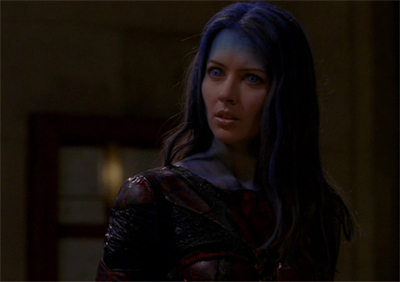
This is obviously a question Joss Whedon asked again and again, but in the fifteenth episode of season 5 of Angel, “A Hole in the World”, he may have found the definitive answer.

Find out more after the jump!
Cosmicisim
H.P. Lovecraft coined the term “Cosmicism” to describe the nature of the “horror” in his writing: that there’s no underlying consciousness in the universe. That it’s a big empty void, full of pinpricks of burning gas, with nothing out there that recognizes humanity — let alone individual humans — as possessed of any significance. Perhaps this is more terrifying to a so-called “Chosen One”, fueled by prophecy, superpowers and a conviction that what they’re doing is “right”, or even that the idea has any meaning.
By the fifth season of Angel, the overarching theme of the show had become the question of complicity. Angel has saved the world (a lot), and is undead and well. His companions have joined him at the Los Angeles office of a successful law firm (evil), and they try their best to fight the good fight within the parameters established by their extradimensional demonic patrons (“The Senior Partners”). Save a helpless victim, but have her sign a release, and pause for a photo-op. Accrue unlimited legal expertise for street-level vampire hunter Gunn, whip up a fab lab for physicist Fred, give Wes a multidimensional library he can access through a single book (and this was four years before the launch of the first Kindle). But there’s always a cost.
Paying The Price
The show had explored the inhuman side of the cosmic in season 4, as it characterized the show’s “Powers That Be” as something not too different from the Senior Parters’ machinations. Particularly in episode 17, “Inside Out“: Angel’s contact Skip, and and a rogue Power are shown to have used Cordelia as a pawn in their schemes for ascension – wherein humans don’t matter, though their worship is handy.
Some things are just bigger than the heroes, the villains, and the whole world. And maybe *that* can scare a vampire.
Final Thoughts
Obviously this wasn’t a universal theme of the Buffyverse. There are times when the “First Evil” got its deadlights punched out. And yes, once in a while, “Higher Powers” righted some of their own wrongs. Sometimes there were individual supernatural with conscious intent. But in the end, Lovecraft’s conception of cosmic horror was that on a fundamental level, it’s not just that the universe itself is against you. It’s not malice, and it’s not deliberate; paranoia doesn’t enter into it. Cosmicism just says that human beings just don’t matter. And when your life is an endless series of battles for a higher purpose, nothing’s as scary as the idea that there’s nobody paying attention.